









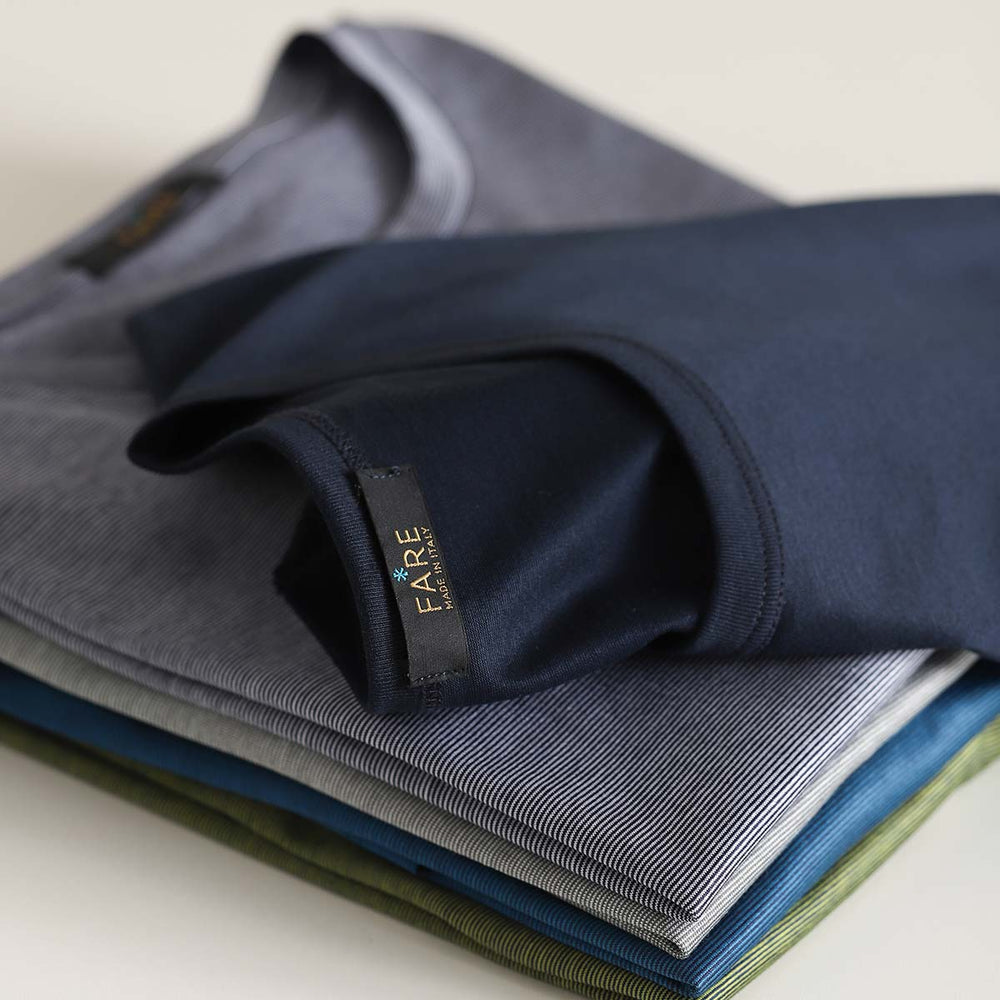
The History of Underwear #Part 1: The T-SHIRT
The T-shirt is not the oldest item of men's clothing, but it can probably claim to be the simplest. It is certainly among those with the most evocative power: a simple cotton fabric that can 'give voice' to a brand, an artistic model, a political movement.
However, long before graphic designer Milton Glaser created the famous logo "I❤️ NY" and before Alberto Korda's photo of Che Guevara ended up on the chests of millions of people, the white t-shirt was a humble piece of underwear to be kept hidden.

*Some sailors playing cards below deck on a US Navy ship during World War II.
The origins of the T-shirt are linked to military regulations.
Around 1913, the revision of the British and American Navy uniforms established that sailors should wear a type of undershirt and a short-sleeved shirt respectively, an evolution of the shirt with a square neckline and shoulder fastening worn since 1880. The choice of white, which is still the most common color for T-shirts, was due to several reasons: it matched well with the rest of the uniform, and it was the cheapest because it did not require dyeing. Furthermore, being more prone to getting dirty, it encouraged greater personal care and hygiene.
The companies that led to the T-shirt as we know it today are mainly two. In the period preceding the First World War, the English company Thomas A. Hill & Co. - founded at the end of the nineteenth century and later known as Sunspel - had exported long-sleeved, lightweight cotton underwear to tropical climates, particularly to the English colonies in the Far East.
Meanwhile, Jacob Goldfarb, an American fabric merchant, had marketed an updated version of a T-shirt-like shirt under the Fruit of the Loom brand, which he produced in 1910. Around 1930, Hanes entered the market, the other main producer of T-shirts and creator of the Beefy T model, as well as the first company to commercialize promotional T-shirts, particularly for the release of the film The Wizard of Oz in 1939.
The popularity of the simple T-shirt grew more and more, and by the 1950s it had become a symbol of teenage rebellion and the rock 'n' roll rebel generation.

*Marlon Brando, in the film A Streetcar Named Desire (1951).

*James Dean, Rebel Without a Cause (1956)

*Paul Newman, The Hustler 1961 photograph by Everett
Leave a comment